A small chipmunk poked her head out of the rain gutter and eyed me warily. A blue jay stopped, squawked loudly. Woodchucks and rabbits grazed, grey squirrels hopped. We were, all of us, emerging from cozy wintering places, stepping outside on one of the first warm days of Spring, and all doing pretty much the same thing—rummaging for fresh, free, wild, healthy, easy, and abundant food (i.e., weeds).
My little neighbors, expert foragers, probably pegged me easily as an amateur. They get right down to business. I hesitate, inspect, Google, try a tiny leaf. I high-five (Yes!) when I make a simple discovery. This time, in two of my patio containers, it was a lovely ruffled green called henbit.

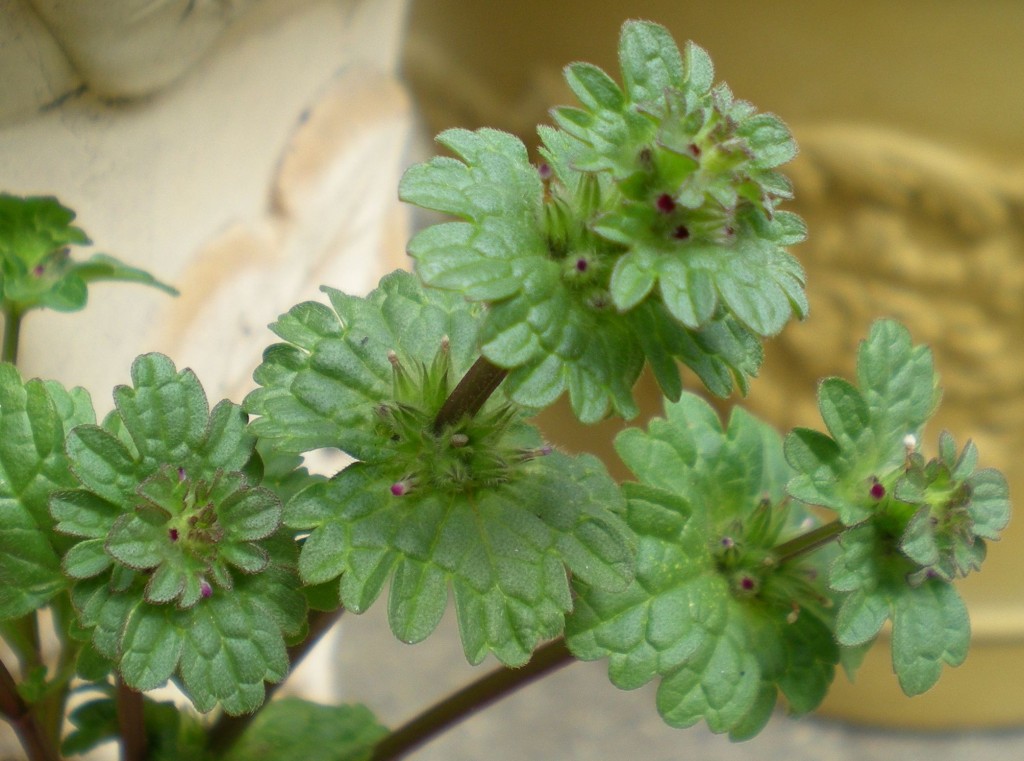
Henbit (Lamium amplexicaule) is a winter annual from the mint family. It has a square stem and heavily lobed, scalloped and rounded leaves that extend on petioles near the base of the stem, but attach to the stem forming little umbrellas near the top. In the springtime, henbit produces gorgeous tiny purple flowers.
My henbit appeared in March and is still growing well in April, but it probably won’t last past June, so I get down to business.

The stem, flowers, and leaves of henbit are edible, and it tastes a little like raw kale, not like mint, more like grass. OK, so it is not dill or basil, but you can add raw henbit to wraps, spring rolls, salads, or green smoothies. I’ve eaten it several times on this simple cucumber sandwich.
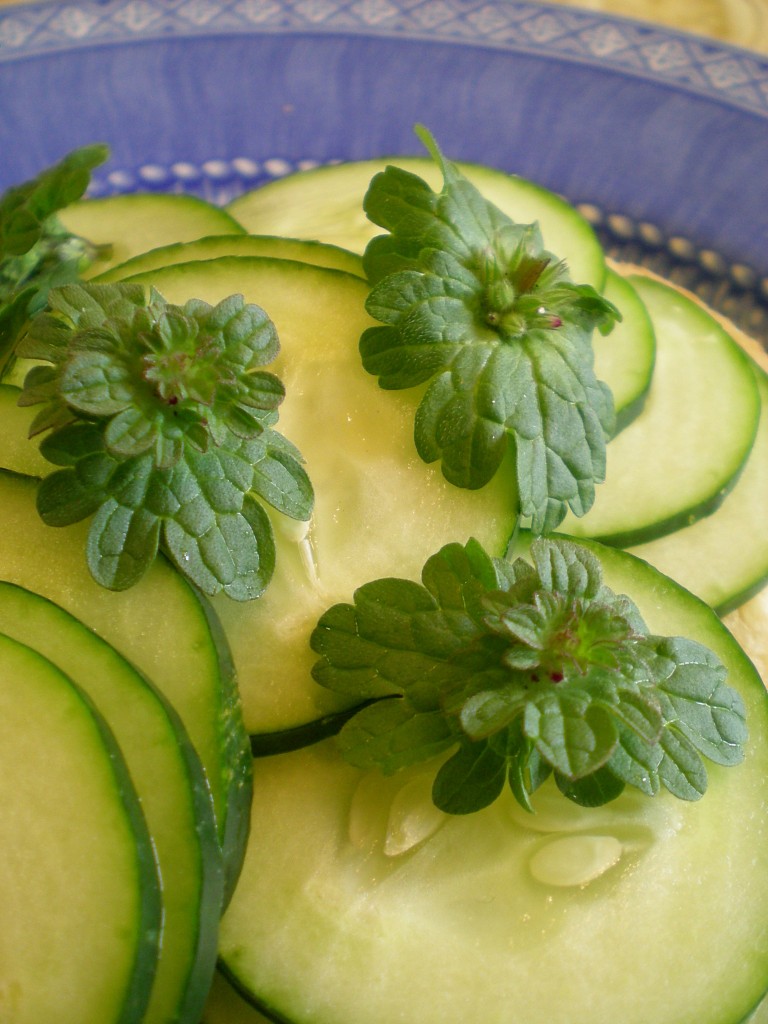
Henbit and cucumber sandwich
Wash an organic cucumber and slice it as thinly as possible with a serrated knife (or a mandoline slicer, if you have one). Lay the cucumber slices on a piece of your favorite fresh bakery bread. Add some henbit, your favorite dressing, another slice of bread, cut into squares, et voilà. Too simple. (If you don’t have henbit, use dill leaf or other fresh greens instead.)
Henbit nutrition
It’s hard to find nutritional information on henbit. (If you have it, please share it.) As a wild leafy green, picked fresh and eaten raw, it is likely much more nutritious than its cultivated cousins. The health benefits of edible wild greens, in general, make henbit well worth a try.
Henbit is also used as an herbal remedy, as an anti-rheumatic, diaphoretic (sweat inducer), excitant, febrifuge (fever reducer), laxative and stimulant, according to naturalmedicinalherbs.net.

Henbit tips
If you find henbit, or any other new wild green, start small. Be absolutely sure of the plant’s identification, and eat just a bit at first. I don’t venture farther than my garden and patio containers—areas free of pesticides, car emissions, or other unsavory dressings (as far as I know). Then again, I live in the urban fringe of Philadelphia. If you live in the wilderness, well, then you probably already know.
Plants that look similar to henbit are Lamium purpureum, known as red or purple deadnettle or archangel, and Glechoma hederacea, known as ground ivy or creeping Charlie. If the leaves near the top of each stem are not attached directly to the stem, then the plant is not henbit. These three plants are often confused. Nonetheless, you can eat them all, in moderation.
So please don’t poison your edible weeds. How about a nice big salad or a sandwich instead? If you’ve got a lot, invite the neighbors. Happy Spring.
Come forth into the light of things. Let nature be your teacher. ~ William Wordsworth
© Copyright 2011, Laura J. Rongé, Ciel Bleu Media, healthiveg.com. All rights reserved.
Disclaimer—The articles here are not intended as medical, nutritional, or other professional advice. The ideas presented are my own, unless otherwise noted, and are for informational purposes only. Please use this information with discretion.